
Road
Operational efficiency is increased through improved communication, availability of data for better coordination and the ability for the port and industry to work together.
Fremantle Ports invests in systems to improve the efficiency of supply chain activities in the port precinct with positive results. These award-winning initiatives include a congestion management system and a truck
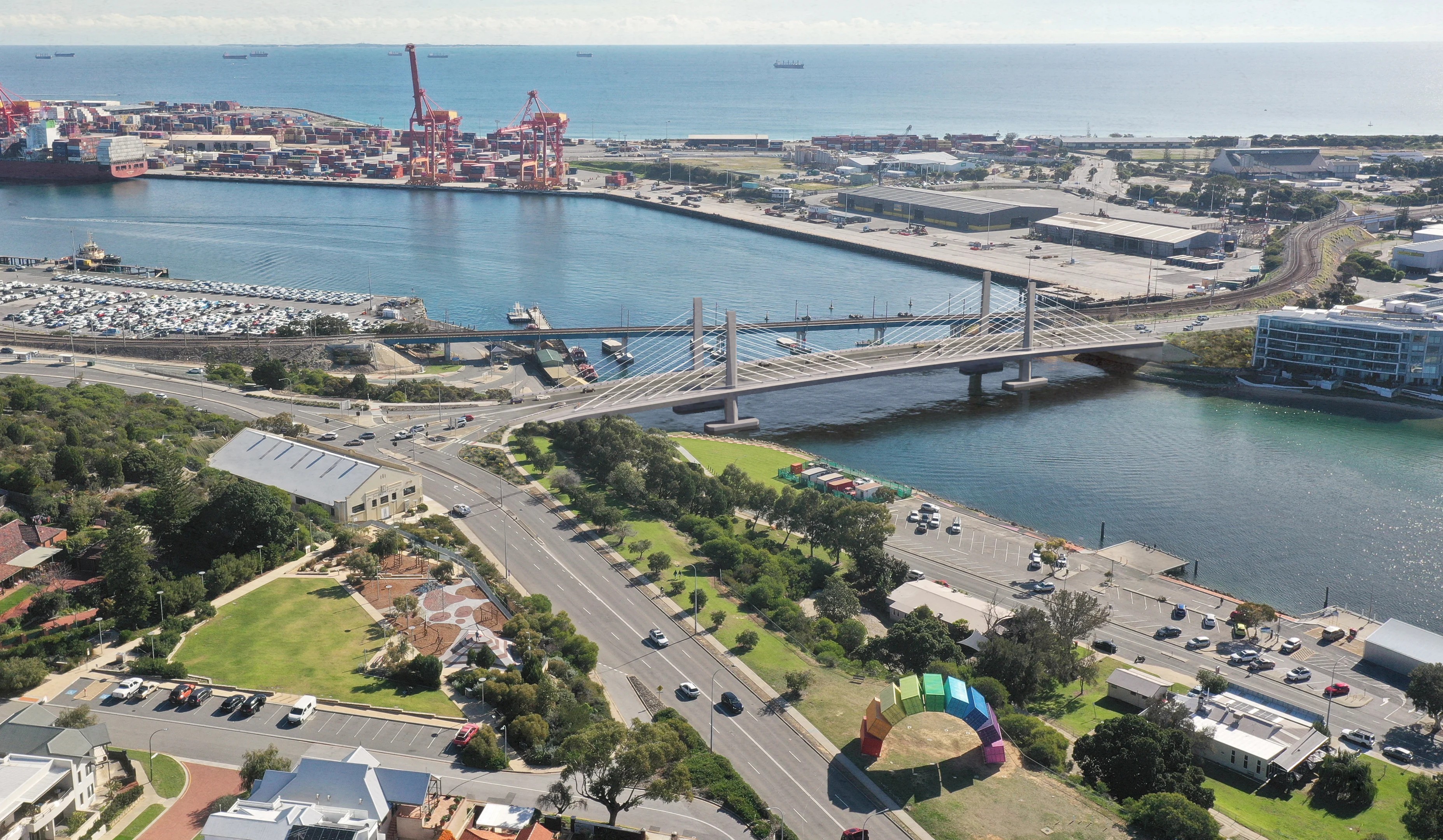
Swan River Crossings - Fremantle Traffic Bridge closure
Fremantle Ports is taking steps to prepare for the closure of the Fremantle Traffic Bridge in early 2026 to ensure the port keeps operating successfully. We are aiming to reduce our daily traffic movements between Victoria Quay and North Quay over Stirling Bridge.
The steps include:
- Setting up operational facilities at North Quay to reduce daytime operational travel over the bridge.
- Reviewing shipping schedules to reduce operational travel over the bridge during peak periods.
- Working with the Heavy Freight Network to identify ways to reduce heavy freight operations during peak periods. The Western Australian Government is progressing this work to encourage changes such as increased rail usage.
- Encouraging employees to investigative flexible working arrangements, such as travelling to work outside of peak times, catching public transport or carpooling.
More information about the project is available on the Main Roads WA Swan River Crossings project page.
Congestion management
System features:
- Logging into the CMS software activates a control program and a series of Variable Messaging Signs (VMS) throughout the port’s environs that ask drivers to divert to the purpose-built TMA.
- An Automated Number Plate Recognition (ANPR) camera captures truck details at TMA entry, linking to a ‘white list’ of previous entries to display port-related information on a cab-height check-in screen; driver confirms the entries and adds any additional information.
- After registration, driver parks vehicle in the TMA, maintaining a view of the TMA VMS or a monitor within the TMA truckstop (café and fueling facilities).
- Transport operators at their offices are also able to view a TMA truck cam, which provides regularly updated, multi-perspective views of the TMA.
- As congestion clears, vehicles are called
up on the TMA VMS according to time slot,first-come first-served , with vehicles in a virtual queue. - Trucks are removed from the TMA VMS automatically by an exit ANPR camera to ensure only valid, current call-ups remain on those screens.
- Arriving trucks are vetted at the site’s entrance, to prevent illegitimate arrivals and ensure fairness and system integrity.
- Finally, when the issue causing the vehicle diversion has been resolved, a ‘Cessation’ logic filters newly arriving vehicles with those exiting the TMA in
attempt to ensure queuing integrity.
See the Congestion Management System Operations Manual (for site users).
Industry information
Heavy vehicle policies Collapse and expand this accordion
Out-of-Gauge Guidelines Collapse and expand this accordion
SOLAS VGM Handbook Collapse and expand this accordion
SOLAS (MO42) - possible process Collapse and expand this accordion
Container Weight Verification Fact Sheet Collapse and expand this accordion
CoR/SOLAS app Collapse and expand this accordion
A Guide to Container Weight Declarations Collapse and expand this accordion
Research
North Quay Truck Survey Collapse and expand this accordion
Truck Productivity Study Collapse and expand this accordion
.tmb-card500.jpg?Culture=en&sfvrsn=614764a1_1)
.tmb-card500.jpg?Culture=en&sfvrsn=efce6706_1)
.tmb-card500.jpg?Culture=en&sfvrsn=9d611726_1)
Find out how you can explore the port or get ferry and cruise info...